Founded in 1887, McMaster University is widely regarded as one of the world’s leading research-intensive universities. Our researchers are committed to advancing human and societal health and well-being.
Ranked 83rd overall in the 2016 Academic Ranking of World Universities, McMaster is the home of problem-based learning – our signature teaching method. Pioneered at McMaster and adopted by institutions around the world, this innovative approach opens young minds to new ideas and hones the critical thinking skills needed to create healthy communities in a complex and changing world.
At McMaster, collaborative thinking is a gateway to greater intelligence and greater optimism. In short, it’s helping us create a brighter world.
La recherche ne se demande plus si on peut vivre plus longtemps, mais si on est prêts à investir – sérieusement, équitablement – dans ce qui nous fera vivre mieux.
Buildings are seen from the observation deck of the CN Tower as smoke from forest fires in Northwestern Ontario blankets Toronto on July 16, 2026.
THE CANADIAN PRESS/Cole Burston
Mutations that occurred tens of thousands of years ago made humans uniquely sensitive to particulate air pollution.
Gad Saad speaks with attendees at the 2023 AmericaFest at the Phoenix Convention Center in Phoenix, Arizona.
Gage Skidmore from Surprise, AZ, United States of America, CC BY-SA 2.0 <https://creativecommons.org/licenses/by-sa/2.0>, via Wikimedia Commons
Some Canadians may agree with Gad Saad’s portrayal of Canada a leftist, woke hellscape. But many don’t, making him a highly unreliable narrator on Canada as he moves to the U.S.
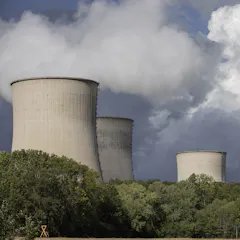
The Cattenom Nuclear Power Plant in Cattenom, eastern France.
(AP Photo/Jean-Francois Badias)
As Canada develops new nuclear projects, some might worry that hotter weather could undermine nuclear reliability. However, France’s experience this summer suggests otherwise.
Le vieillissement n'est pas une catastrophe naturelle; c'est le résultat prévisible du progrès social.
(Unsplash/Curated Lifestyle)
Le vieillissement de la population canadienne est une réussite, pas une crise. Reste à bâtir la meilleure société au monde pour bien vieillir.
Crisis situations are characterized by incomplete information, time pressure, unprecedented leadership challenges with unclear options and a threat to the group’s reputation.
(Pexels/Thirdman)
Research has moved past the question of whether we can live longer. The new question is whether we’re willing to invest — seriously, equitably and early — in the things that will help us live better.
Inflation has fallen sharply from its 2022 peak, but many Canadians are still feeling the effects of higher prices.
THE CANADIAN PRESS/Ethan Cairns
Lower inflation does not mean prices will return to where they were before. Inflation measures the average change in prices over time, not which specific prices are rising or falling.
Many achievement gaps begin long before children write their first standardized math test.
(Piqsels/Id Frela)
Québec’s Bill 9 demands the public sphere be free of visible religion, even when expressions of religion take are obligations its adherents cannot set aside.
An acidifying body of water in Yukon. Acidification is driven by the weathering of rocks, which release acid, sulphate and toxic metals into groundwater and streams.
(Elliott Skierszkan)
Researchers found that some bodies of water have become highly acidic within only a few years.
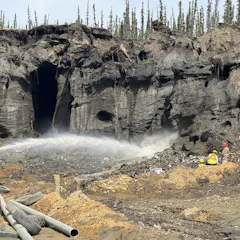
A hydraulic monitor thaws permafrost with high-pressure water in the Klondike goldfields, Yukon — mining exposures that researchers used to access ancient ground ice and fossil records.
(Duane Froese)
Permafrost holds an extraordinary molecular record of ancient life — and we are only now learning to read it, just as warming begins to erase it.
Research ethics boards’ regulations can sometimes produce an unintended consequence: overprotection through policies that restrict the participation of people and communities historically excluded from research, such as racialized communities, Indigenous people and recent immigrants.
(Unsplash/Curated Lifestyle)
An ethics process must not become so preoccupied with the potential harm of participation that it overlooks the certain harm of exclusion.
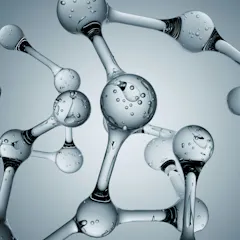
The International Renewable Energy Agency projects that global ammonia demand could approach 700 million tonnes a year by 2050, nearly four times more than what is produced today.
(Unsplash)
Canada’ aging population is a marker of national success, not a crisis. The question is whether we will seize this moment to build the strongest aging society in the world.
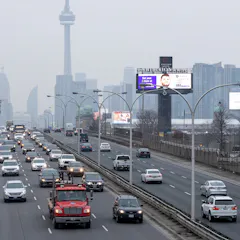
Traffic moves along a highway in Toronto, Ont. Cities built around a single transportation option, like private vehicles, are more vulnerable to disruption.
THE CANADIAN PRESS/Frank Gunn
Resilient urban mobility can be created by giving people options that ensure they can still move around when a shock affects one form of transportation.
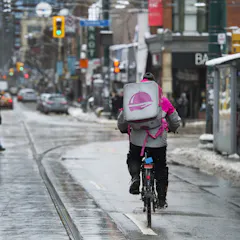
Canada backed global rights for gig workers, but its’ own workers’ right to strike is under pressure from governments.
THE CANADIAN PRESS/Nathan Denette
Canada supports the first international treaty protecting platform workers. The same government is weighing a proposal that could make it difficult to legally strike in the rail and marine sectors.
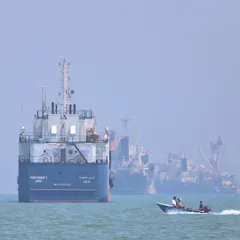
A small motorboat passes anchored vessels in the Strait of Hormuz off Bandar Abbas, Iran, June 11, 2026.
(Amirhosein Khorgooi/ISNA via AP)
A peace deal has reopened the Strait of Hormuz, but insurance premiums, mine clearance and a container shortage across two continents suggest the disruption is far from over.