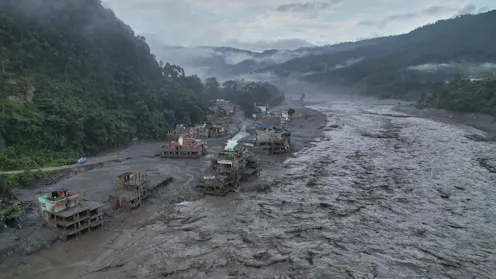
Hindus know it as the dwelling place of Shiva, Tibetan Buddhists as the abode of Demchog, and Jains as the site where Rishabhanatha, their first spiritual teacher, achieved liberation.
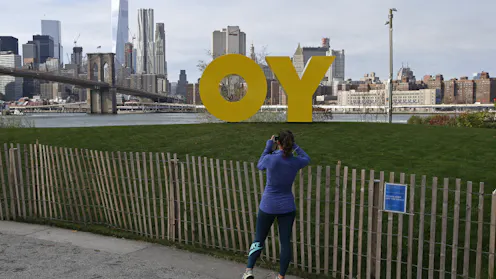
A sculpture by Deboray Kass that says ‘Yo’ from one side and the popular Yiddish expression ‘Oy’ from the other stood on display in Brooklyn Bridge Park in New York in 2015.
AP Photo/Kathy Willens
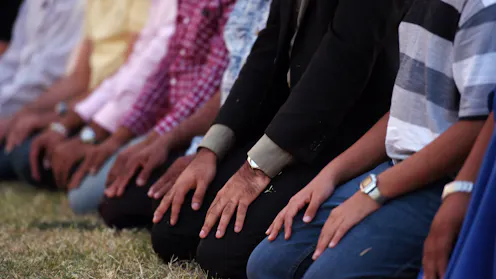
After 9/11, suspicion of Islam hardened into an assumption in Texas that Muslim identity itself signals danger, writes a scholar of constitutional law.
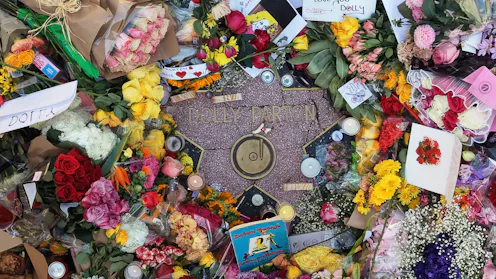
The legendary artist often spoke about her own evolving faith.
AP Photo/Jae C. Hong
Shannon Fogg, Missouri University of Science and Technology
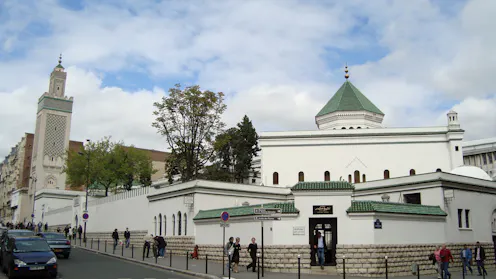
The Grand Mosque of Paris has stood for a century as a memorial to Muslim soldiers and a nuanced symbol of French colonialism.
Theatergoers arrive for ‘Leopoldstadt,’ a play about several generations of a Jewish family in Vienna, at Wyndham’s Theatre in London in 2020.
Isabel Infantes/AFP via Getty Images
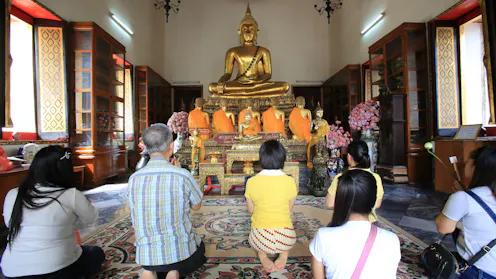
Thai Buddhism involves daily rituals and collective acts of worship, unlike the individual-focused emphasis on meditation often found in Western Buddhist communities.
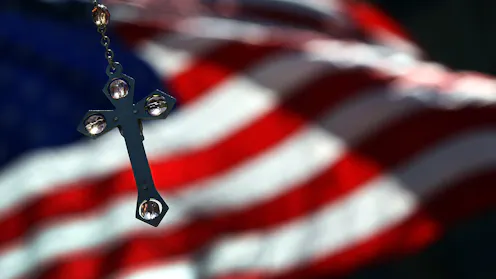
A sense of threat can fuel Christian nationalism.
Win McNamee/Getty Images
Two political scientists explain why Christian nationalist beliefs endure.
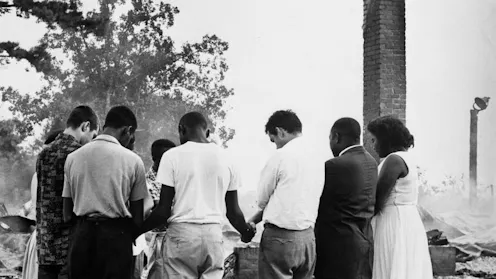
Members of the Student Nonviolent Coordinating Committee pray beside the ruins of a burned church near Dawson, Ga., in 1962.
Bettmann Archive/Getty Images
More than 100 Black churches across the South were targeted from the 1950s-70s. Another wave of violence followed in the ‘90s – and there have been attacks in recent years, too.
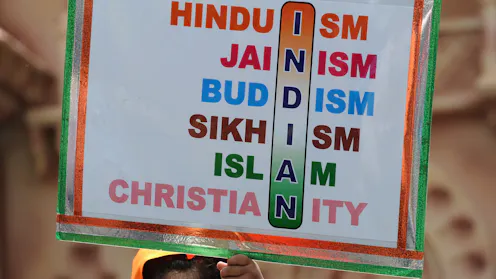
When India became independent in 1947, its constitution affirmed a commitment to religious diversity and pluralism.
Photo by Indranil MukherjeeI/AFP via Getty Images
A false rumor started in the early 20th century that the Japanese emperor would convert to Islam. It helped Japan build alliances with Muslims across Asia.
Extreme wealth can concentrate power in the hands of a few.
Flavio Coelho/Getty Images
American churches could not rely on the state for financial support. Private philanthropy helped them survive – and shaped the country’s religious diversity today.
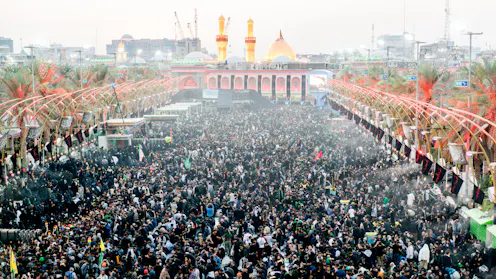
Pilgrims crowd the Imam Husayn shrine in Karbala, Iraq, during Arbaeen, one of the world’s largest annual religious pilgrimages.
MASTER/Moment via Getty Images
Each year, millions of Shiite Muslims walk to Karbala to honor Husayn, the prophet’s grandson, whose death continues to shape their faith.
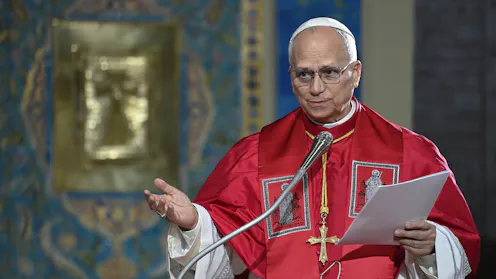
Pope Leo XIV, whose first encyclical discusses artificial intelligence, speaks at the Basilica of Our Lady of Africa on April 13, 2026 in Algiers, Algeria.
Matteo Pernaselci - Vatican Media via Vatican Pool/Getty Image
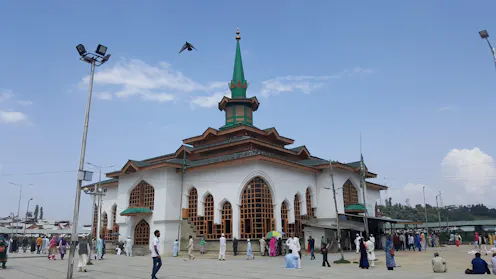
Kashmir’s history as a center of learning and the arts for Hindus, Buddhists and Muslims offers another way of understanding the region – one shaped by centuries of religious coexistence.
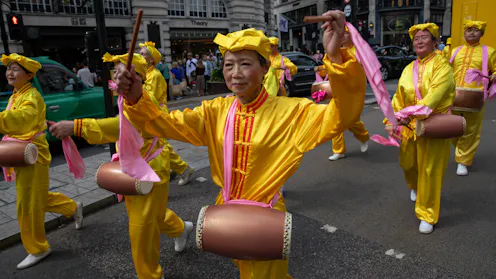
Falun Gong practitioners march in London, calling for an end to persecution by the Chinese Communist Party.
James Willoughby/SOPA Images/LightRocket via Getty Images
An anthropologist who conducted fieldwork among Falun Gong practitioners explains the movement’s beliefs and why its followers continue to resist the Chinese government.
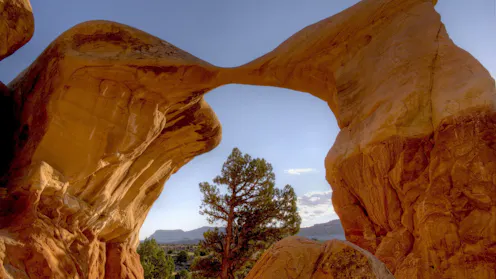
A view of the Grand Staircase-Escalante National Monument near Escalante, Utah.
John Fowler from Placitas, New Mexico, U.S. via Wikimedia Commons
Native religions are tied to living landscapes, not points on a map. A scholar of Indigenous studies explains why reducing the protected area has profound religious and cultural consequences.
Rats, mice and other rodents are often considered pests.
Prot Tachapanit/iStock via Getty Images Plus
Many faith groups supporting immigrants root their mission in the idea of ‘accompaniment,’ which springs from Catholic social teaching.
Nitrogen tanks holding tens of thousands of frozen embryos and eggs sit in a lab at New Hope Fertility Center in New York on Dec. 20, 2017.
Carolyn Van Houten/The Washington Post via Getty Images
Mindfulness can improve health and well-being, but it may not work for everyone. Buddhist teachings suggest that how it is practiced – and who guides it – matters.
At times, feeling personally grateful to someone can feel like a big ask – but there are other forms of gratitude.
Focus Pixel Art/Moment via Getty Images
Mark Schroeder, USC Dornsife College of Letters, Arts and Sciences
Struggling to feel grateful? Try thinking differently about what caused the person’s actions.
Research suggests that AI models tend to favor Western moral frameworks when judging people’s actions.
mirjanajovic/DigitalVision Vectors via Getty Images
Generative AI’s overemphasis on Western moral concerns could reinforce global disparities in sensitive applications such as public health messaging and global communication.