E-Paper


Delhi’s voter count dip steep, but not unusual for big cities
An HT analysis shows that a third of electors being deleted is indeed a big number, but par for the course for urban centres

 Prefer HTon Google


The Election Commission of India (ECI) published the draft electoral rolls for Delhi on Monday after the completion of the enumeration phase of the Special Intensive Revision (SIR) exercise. The draft roll has 9.7 million electors, 4.8 million (32.8%) less than the 14.5 million electors on the rolls before SIR. In other words, one in three electors on Delhi’s electoral roll was removed in the first phase of SIR. Is this an unusually high rate of cuts? An HT analysis shows that a third of electors being deleted is indeed a big number, but par for the course for urban centres comparable to Delhi’s size and urban population.
Deletions in Delhi are the highest of any state or UT
Delhi’s 33% deletion looks like a big number because it is. This is the highest deletion rate at the draft roll stage among 30 states and Union Territories where the SIR has been conducted, and far ahead of the deletion rate in any comparable state. The next highest deletion rate in a big state is in Telangana, where 21.6% names were cut in the draft roll, over 10 percentage points lower than in Delhi. This is what makes deletions in Delhi appear staggering.
To be sure, the UT of Dadra and Nagar Haveli and Daman and Diu, did see 29.7% names deleted in the draft roll, a number comparable to Delhi’s. However, the UT’s pre-SIR roll did not even have half a million electors compared to 14.5 million in Delhi; it also does not have a legislative assembly like Delhi.
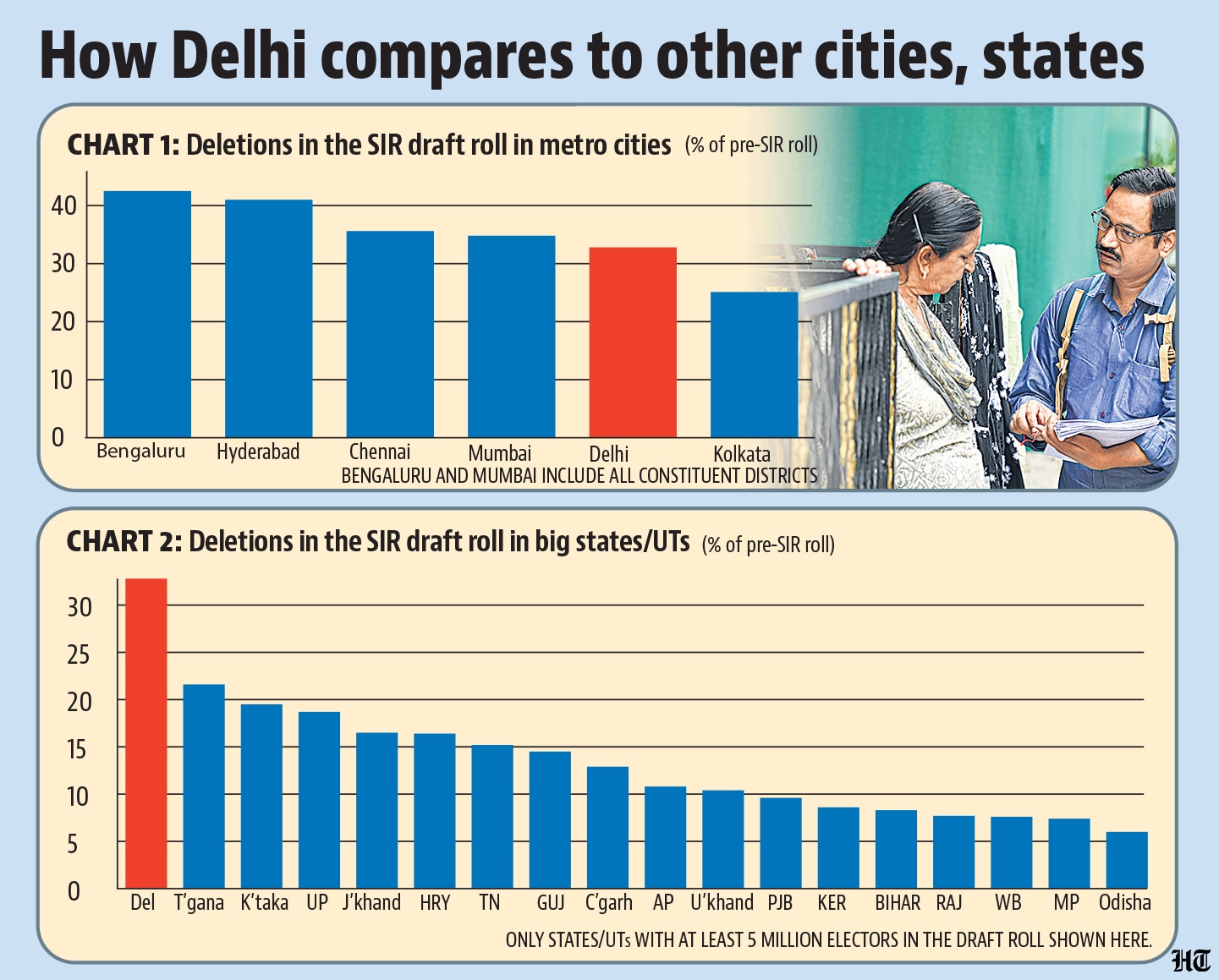
…but below average for cities the size of Delhi
While Delhi’s deletions are the highest for any state or UT, such rates have been the norm for big cities in the SIR exercise. Among the six metros – Mumbai, Delhi, Kolkata, Chennai, Bengaluru, and Hyderabad – Delhi’s 32.8% deletions at the draft stage are second lowest. The deletions in these metros in descending order are as follows: 42.5% in Bengaluru (constituent districts combined), 41% in Hyderabad, 35.6% in Chennai, 34.8% in Mumbai (constituent districts combined), 32.8% in Delhi, and 25.1% in Kolkata.
In other words, the high rate of deletion in Delhi is consistent with a pattern seen across most states: a higher rate of deletion in urban areas compared to rural areas. This could partly be due to high influx of economic migrants to urban centres. It is possible that such migrants were enlisted twice — once in the cities they moved to for work and another in their rural home -- and have chosen to enlist in the rolls of the latter when forced to make a choice.
To be sure, migration is unlikely to be the complete reason behind such high deletion rates because the urban population share of districts is not a perfect predictor of SIR deletions. Moreover, the trend described above was not seen at all in Odisha.
While Delhi appears to follow the general trend of high deletions in urban areas, it is possible that the net deletion in Delhi after the completion of SIR will be smaller than the number seen at the draft stage. This is because SIR is a two-step process. The draft roll is the result of only the first phase of enumeration. This will be followed by a claims and objections phase, where people can contest deletions and seek to add their name to the rolls up to September 30, before the final rolls are published on November 4. In all states where the SIR has been completed (except Goa and West Bengal), net deletions in the final roll were less than at the draft stage.
For example, deletions in Chennai fell from 35.6% at the draft stage to 29.3% in the final roll.
However, deletions in Chennai continued to be the highest for any district in Tamil Nadu and are higher than for any state yet. This means that Delhi is more likely to continue to be the state/UT with the highest deletions than not.
For example, among the two metros where the SIR final roll has been published, deletions in Chennai decreased from 35.6% at the draft stage to 29.3% in the final roll and those in Kolkata increased from 25.1% to 25.5%, following the broad trend of their respective states.
To be sure, deletions in both continued to be the highest for any district in their respective states and is also higher than for any state so far. This means that Delhi is more likely to continue to be the state/UT with the highest deletions than not.