
 E-Paper


Naoroji portrait gets fresh lease, to be exhibited at London’s National Portrait Gallery
The painting, which spent decades at the historic India Club in London, will be exhibited at the National Portrait Gallery in London from Wednesday in an exhibition titled ‘Empire and Resistance’

 Prefer HTon Google


MUMBAI: Nearly eight decades after it was painted, a portrait of Dadabhai Naoroji, the ‘Grand Old Man of India’, has acquired a new lease of life. The painting, which spent decades at the historic India Club in London, will be exhibited at the National Portrait Gallery in London from Wednesday in an exhibition titled ‘Empire and Resistance’ after being restored by specialists at The Courtauld Institute of Art.
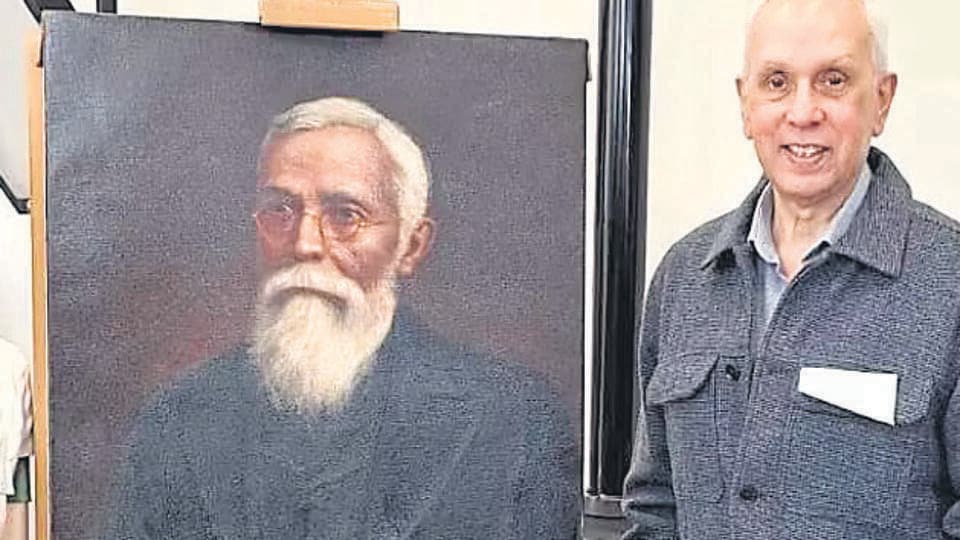
The 756 x 615 x 24 mm work executed in the Western tradition of realism is an oil-on-canvas portrait by Bombay-based Sorab MF Pithawalla (1911-1959). It has been loaned to the gallery for three years, renewable, by its owner, Yadgar Marker, 75, a UK-based Parsi of Karachi origin who acquired the India Club in 1997. Its restoration is complete three years after the club shut, prompting Marker to entrust it to conservation experts.
Born into a priestly Parsi family, Naoroji was one of the most important torch bearers of India’s independence from British colonial rule and a founder of the Indian National Congress. After he moved to the UK, he became the first British-Indian member of parliament, where he served from 1892 to 1895. His advocacy for India made him one of the most important figures in the early Indian nationalist movement.
The portrait has an unusual journey. According to Firoza Punthakey Mistree, honorary advisor and curator at the FD Alpaiwalla Museum dedicated to the Zoroastrian community in Mumbai, it was painted in Bombay around 1946, a year before Indian independence. “It was originally offered to hang in the UK Parliament but was dismissed as “unfit” for the space,” said Marker.
The portrait found a home at the India Club in Strand, a landmark place for generations of Indians in London, and displayed prominently at the entrance. There was even an attempt to steal it, Marker told HT. He said, “A man once took the painting and began walking down the stairs but was intercepted by club employees…”
For decades, the portrait aged as the fragrance of bhuna mutton, prawn curry, masala dosa, rasam, chilli paneer and dal wafted up from the club’s kitchen. Plans for the club’s redevelopment forced the club to shut in 2023, which saw the portrait make its way to the Courtauld Institute for conservation. According to Marker, the process took less than 3 years.
Naoroji died in 1917, nearly three decades before the portrait was made. The painting was therefore likely based on photographic references. But those who have seen it closely say Pithawalla captured an image that was “beyond a physical likeness”, says founding director of the Delhi-based Parzor Foundation, Dr Shernaz Cama, an authority on Parsi art and culture.
The Courtauld Institute did not comment on the restoration to HT. According to ‘Painting Pairs 2024–25: Sorab Pithawalla, Portrait of Dadabhai Naoroji (1946)’ by Benjamin Singer and Ursula Griffiths, “Technical examination has revealed a remarkably detailed picture of how Pithiwala constructed the work. The painting is executed on a densely woven canvas, believed to be linen, stretched over a wooden, four-member keyable stretcher. Its preparation includes a chalk-and-animal-glue ground followed by a lead-white oil priming layer. An additional animal-glue size appears to have been applied over the oil priming. The uneven distribution of excess canvas and the way its corners were folded suggest that the canvas may have been stretched by Pithiwala himself.”
The painting’s journey has come full circle. From being considered “unsuitable” for the House of Commons to becoming part of the cultural memory of the India Club, and now being exhibited at the National Portrait Gallery, it has lived several lives.
—-----------------------------------------------------------------------------------------------------------------------------
Empire and Resistance’ will open at the National Portrait Gallery in London on September 2. Sorab Pithawalla’s portrait of Dadabhai Naoroji will be displayed in Room 23 of the gallery.


Stay updated with all the Breaking News and Latest News from Mumbai. Click here for comprehensive coverage of top Cities including Bengaluru, Delhi, Hyderabad, and more across India along with Stay informed on the latest happenings in World News.


